


Backed by us. Trusted by you.
Victory isn't given. It's earned.
We build our own instruments and carry the pro audio and video brands we trust, for everyone from first-timers to working pros, from your garage to the big stage. Started in 2017.
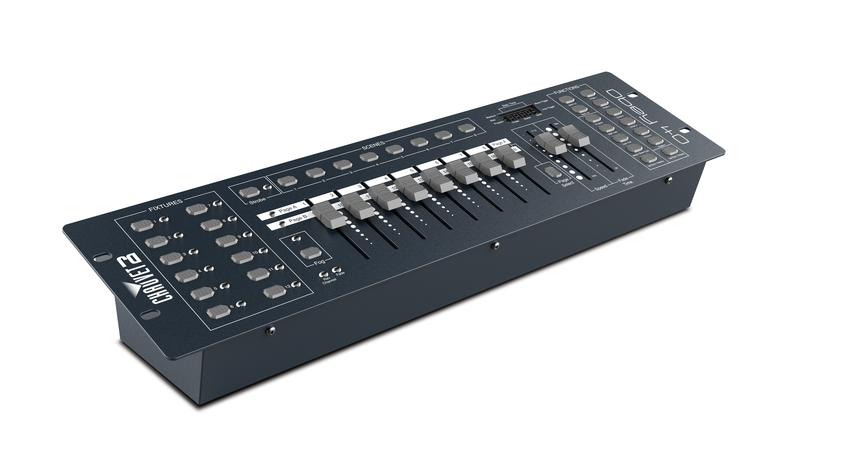
Obey 40 is a compact DMX lighting controller for twelve fixtures of up to sixteen channels, the accessible entry into programmed lighting control.
The first controller most rigs get.
The Obey 40 is the next step up from the Obey 10, allowing for control of up to 12 fixtures at 16 channels each. With a slightly larger size comes a larger capacity: the Obey 40 has 30 banks on 8 scenes, or up to 240 scenes. The Obey 40 offers the flexibility of its little brother but also adds fog and strobe control and MIDI compatibility.
At a Glance
| Brand | Chauvet DJ |
|---|---|
| Model | Obey 40 |
| Product type | Lighting Controllers |
| Warranty | Chauvet DJ limited warranty |
Do I Need a Lighting Controller?
Not to get started. Chauvet fixtures run automated and sound-active modes on their own, and ILS coordinates a rig without one. A controller matters when you want to call specific looks at specific moments rather than letting the rig run itself.
What Is DMX?
The standard control protocol for stage lighting. Fixtures are daisy-chained on a DMX cable and each is assigned an address, so a controller can address each one individually. It has been the industry standard for decades and it is what makes fixtures from different brands work together.
Wired or Wireless?
Wired DMX is reliable and cheap but means running cable across a venue. Wireless DMX removes the cable, which matters for uplighting placed around a room, at the cost of a transmitter and receiver at each end.
Why Chauvet DJ
Chauvet DJ has been the default answer in mobile DJ and small venue lighting for two decades, built on a simple premise: a lighting rig should set up fast, run without an operator and survive being loaded in and out several nights a week. The ILS system ties fixtures together so a whole rig responds as one without a DMX desk or a programmer, which is the reason a single DJ can run a room's worth of lighting alone. The company is based in Sunrise, Florida.