


Backed by us. Trusted by you.
Victory isn't given. It's earned.
We build our own instruments and carry the pro audio and video brands we trust, for everyone from first-timers to working pros, from your garage to the big stage. Started in 2017.
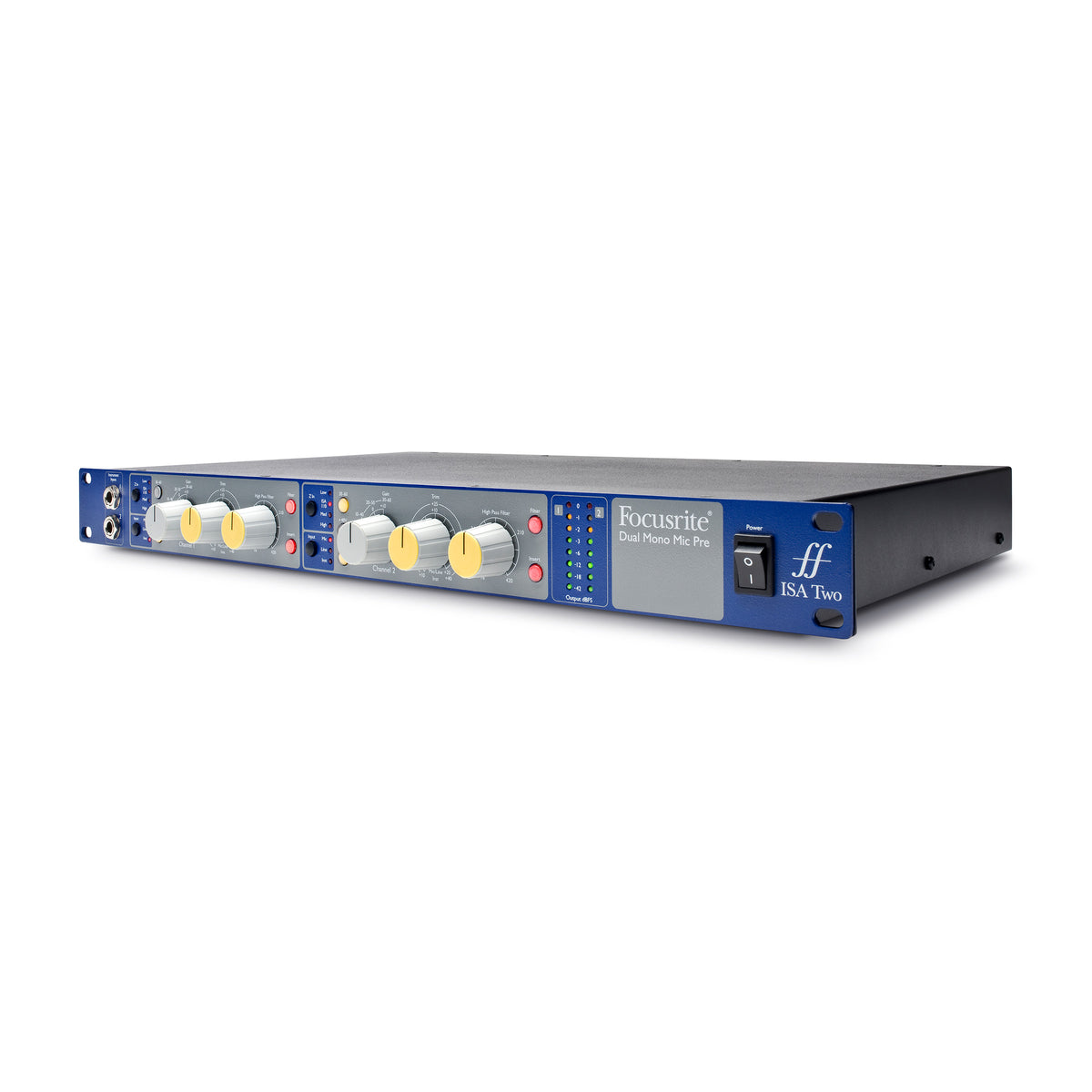
Focusrite ISA Two is a two-channel transformer microphone preamp built on the ISA 110 module from the original Focusrite Studio Console, with two independent channels, switchable input impedance, instrument inputs and high-pass filters.
Two channels of the ISA 110 sound in one rack space.
Overview
The ISA Story goes back to 1985, when Sir George Martin commissioned legendary designer Rupert Neve to design new modules for the console at AIR Montserrat. They were so successful that more were commissioned for AIR London. These original modules form the basis of today’s Focusrite ISA range, delivering the legendary Focusrite sound to leading studios, artists, producers and engineers around the world.
Literally hundreds of hits have been made with the Focusrite ISA Range, and continue to be made today. Focusrite’s ISA Two brings together a totally independent pair of legendary ISA microphone preamps inspired by the original ISA 110 module, combining the best of traditional solid-state electronics with the original input transformer specified by Rupert Neve, the Lundahl LL1538.
Two is a nice round number, ideal for recording, say, a vocal and an instrument, or a stereo piano. But though you may only need two mic pres, you owe it to your craft to choose the best. (And if you need more, we offer ISA 428 Mk II 4-channel and ISA 828 8-channel units too.) Focusrite has made one little adjustment to the mic pre. The original ISA 110 had a single input impedance that was ideal for the mics of the time.
In the ISA Two there are three more, allowing you to get the very best out of any microphone, vintage or modern. Give a vintage mic the input it expects to get a traditional, warm sound. Pair the ISA Two with modern microphones and get the most transparent sound imaginable. Or experiment and pull out the inner character of any microphone you care to try. Couple that with up to 80dB of gain and you can be ready for anything.
ISA at a Glance
| Gain Range (Mic) | 0 dB to 60 dB in 10 dB steps, plus 0 dB to 20 dB continuously variable trim |
| EIN (Mic) | Measured at 60 dB of gain with 150 O source impedance and 22 Hz-22 kHz band pass filter -127 dB |
| Noise (Mic) | Noise at output with unity gain (0 dB) and 22 Hz-22 kHz band pass filter -97 dBu |
| Frequency Response (Mic) | At minimum gain (0 dB)-0.5 dB at 10 Hz,-1 dB at 135 kHz, relative to 1 kHz |
| At 60 DB Gain (Mic) | -6 dB at 10 Hz, -1 dB at 115 kHz, relative to 1 kHz |
| Crosstalk Channel To Channel (Mic) | Mic input, with I/P = 0 dBu, gain = 0 dB @ 1 kHz input to channel A, channel B output = -85 dB |
Who Is the ISA For?
Studios that want ISA preamps for stereo sources, vocals and guitar, or a pair of room mics.
ISA Specifications
| Mic input response | |
| Gain Range (Mic) | 0 dB to 60 dB in 10 dB steps, plus 0 dB to 20 dB continuously variable trim |
| EIN (Mic) | Measured at 60 dB of gain with 150 O source impedance and 22 Hz-22 kHz band pass filter -127 dB |
| Noise (Mic) | Noise at output with unity gain (0 dB) and 22 Hz-22 kHz band pass filter -97 dBu |
| Frequency Response (Mic) | At minimum gain (0 dB)-0.5 dB at 10 Hz,-1 dB at 135 kHz, relative to 1 kHz |
| At 60 DB Gain (Mic) | -6 dB at 10 Hz, -1 dB at 115 kHz, relative to 1 kHz |
| Crosstalk Channel To Channel (Mic) | Mic input, with I/P = 0 dBu, gain = 0 dB @ 1 kHz input to channel A, channel B output = -85 dB |
| Line input response | |
| Gain Range (Line) | -20 dB to 10 dB in 10 dB steps, plus 0 dB to 20 dB continuously variable trim |
| Input Impedance (Line) | 10 kΩ from 10 Hz to 200 kHz |
| Frequency Response (Line) | At minimum gain (0 dB)-0.3 dB at 10 Hz, -1 dB at 80 kHz, relative to 1 kHz |
| Crosstalk Channel To Channel (Line) | Line input, with I/P = 0 dBu, gain = 0dB @ 1 kHz input to channel AChannel B output?= -91 dB |
| Instrument input response | |
| Gain Range (Instrument) | 10 dB to 40 dB continuously variable trim |
| Input Impedance (Instrument) | 2 MΩ |
| Noise (Instrument) | Measured with 22 Hz-22 kHz band pass filterMinimum gain ( 10 dB) = -95 dBu |
| Frequency Response (Instrument) | At minimum gain ( 10 dB)-0.1 dB at 10 Hz,-1 dB at 115 kHz, relative to 1 kHz |
| At Maximum Gain ( 40 DB) (Instrument) | -2.5 dB at 10 Hz, -1 dB at 110 kHz, relative to 1 kHz |
| High-pass filter | |
| Roll-Off | 18 dB per octave (3 pole filter) |
| Frequency Range | Continuously variable from 16 Hz to 420 Hz (-3 dB) |
Why Focusrite?
Focusrite is a British pro audio company whose ISA preamp design goes back to the Focusrite Studio Console. Its Scarlett, Clarett+, Vocaster, ISA, Red and RedNet ranges cover everything from a first home recording to Dante networks in broadcast and professional studios.
Frequently Asked Questions
Are the two channels independent?
Yes. Each channel has its own gain, impedance and filter controls.
Does it have instrument inputs?
Yes. Each channel has an instrument input.
Is this a genuine Focusrite product?
Yes. Victory is a veteran owned dealer and units ship new in original packaging.
Is it covered by a warranty?
Yes. It is covered by the Focusrite manufacturer warranty.
Why Victory Musical Instruments?
Victory Musical Instruments ships Focusrite interfaces, preamps and Dante equipment nationwide with free shipping. For help choosing an interface or planning a system, call 844-687-4208.