


Backed by us. Trusted by you.
Victory isn't given. It's earned.
We build our own instruments and carry the pro audio and video brands we trust, for everyone from first-timers to working pros, from your garage to the big stage. Started in 2017.
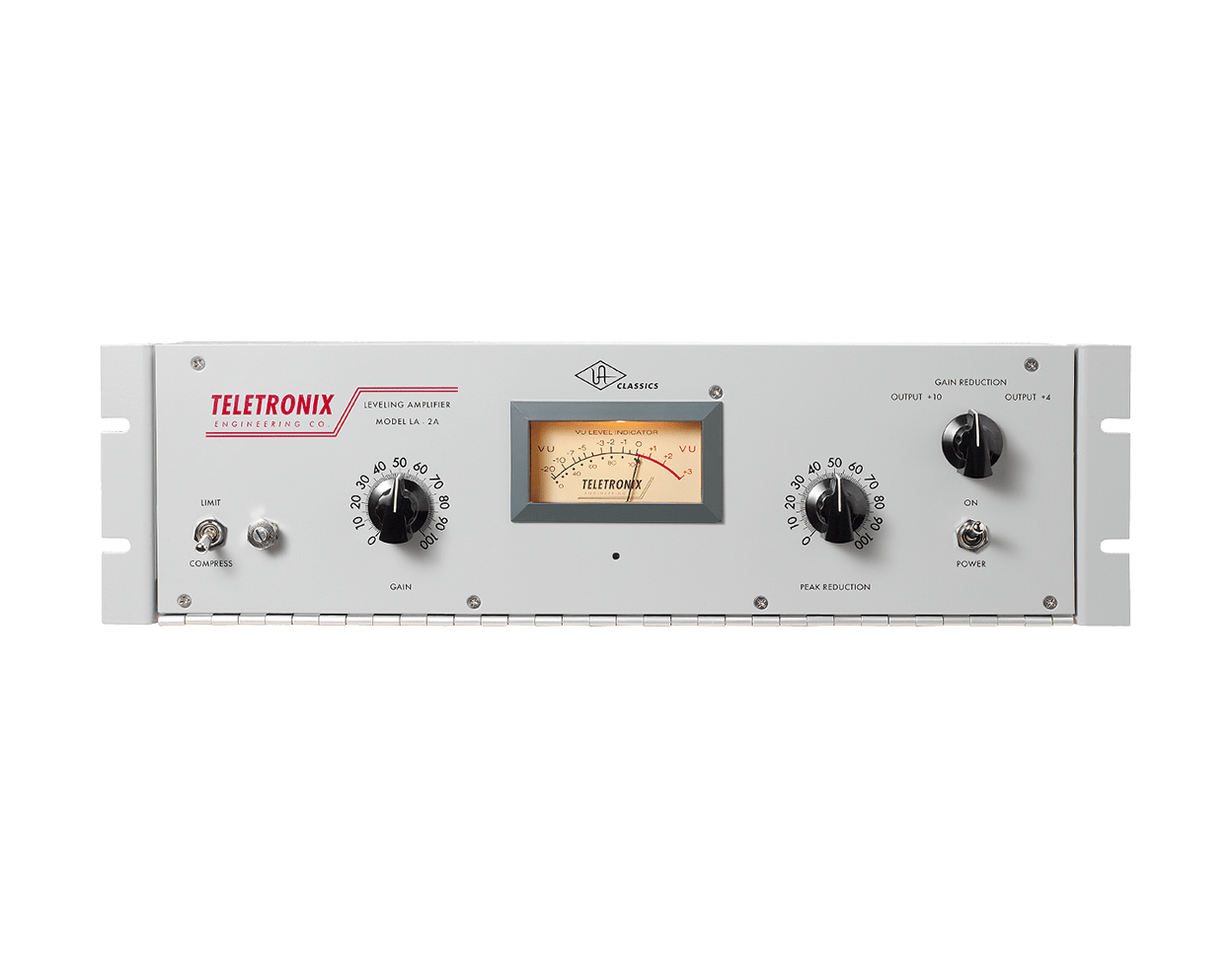
Universal Audio Teletronix LA-2A is a tube-driven electro-optical leveling amplifier in a 3U 19 in. rack chassis, hand-wired point-to-point at UA's Custom Shop in California. It delivers 40 dB of gain with 0 to 40 dB of limiting, a 10 millisecond attack and a two-stage release, at less than 0.5% THD. Frequency response runs 30 Hz to 15 kHz within 1 dB.
Two knobs, and the compression sound most records are built on.
The LA-2A works through a T4 electro-optical attenuator. A light source and a photocell handle gain reduction rather than a VCA or a FET, which is why the response is program-dependent: the release changes with the material rather than following a fixed setting. That behavior is what engineers mean when they call it musical, and it is not something a control can dial in.
There are two controls, Peak Reduction and Gain, plus a Limit and Compress switch. That is the entire interface. The absence of attack and release controls is the design, not an omission, since the optical cell determines both.
The release is genuinely two-stage: roughly 0.06 seconds for the first 50 percent of release, then anywhere from 0.5 to 5 seconds for the remainder. On a vocal that means the loud syllables come down fast while the tail returns slowly enough that the compression never announces itself.
Universal Audio still hand-builds this line in California to the original circuit designs rather than licensing the name out. The company was founded in 1958 by M.T. "Bill" Putnam, who designed the 1176 and the 610, and was revived in 1999 by his sons with the original schematics and, in several cases, the original test gear.
At a Glance
| Type | Tube electro-optical leveling amplifier |
| Attenuator | T4 optical cell |
| Controls | Peak Reduction, Gain, Limit/Compress |
| Gain | 40 dB, plus or minus 1 dB |
| Limiting range | 0 to 40 dB |
| Attack | 10 milliseconds |
| Frequency response | 30 Hz to 15 kHz, +0 / -1 dB |
| Format | 19 in. rack, 3U |
Why Does the LA-2A Have No Attack or Release Controls?
Because the optical cell sets them. The T4 attenuator's photocell has its own recovery characteristic that responds to the signal, so attack sits at roughly 10 milliseconds and release runs in two stages: about 0.06 seconds for the first half, then 0.5 to 5 seconds for the rest depending on what came before. That program-dependent behavior is the reason the unit sounds the way it does.
Who Is the LA-2A For?
Studios tracking and mixing vocals, bass and acoustic sources where the compression needs to be felt rather than heard. It is a mixing and tracking tool rather than a corrective one, and most rooms that own one own it specifically for lead vocals.
What Is the Difference Between Limit and Compress?
The switch changes the ratio behavior of the detector. Compress gives a gentler, lower-ratio action suited to levelling a performance. Limit is more aggressive and catches peaks. Both run through the same optical attenuator, so the character stays consistent.
Can I Link Two for Stereo?
The LA-2A provides balanced stereo interconnection. Call 844-687-4208 to confirm what a stereo pair requires for your specific units before ordering a second.
Connections
| External connections | Jones Barrier terminals and XLR connectors |
| Input impedance | 50, 150, 250, 600 ohms |
| Output load impedance | 50, 150, 250, 600 ohms |
| Input level | +16 dB maximum |
| Output level | +10 dB nominal, +16 dB maximum |
Specifications
| Frequency response | +0 / -1 dB, 30 Hz to 15 kHz |
| Gain | 40 dB, plus or minus 1 dB |
| Distortion | Less than 0.5% THD, 0.25% typical at plus or minus 10 dBm |
| Noise | 70 dB below +10 dBm output level |
| Attack time | 10 milliseconds |
| Release time | 0.06 seconds for 50% release, 0.5 to 5 seconds for complete release |
| Meter | dB gain reduction and dB output |
| Power requirements | 35 watts, 120/240 volts, 50/60 Hz |
| Maximum operating temperature | 160 degrees F |
| Dimensions | 19 in. rackmount chassis, 3U |
| Weight | 13 lb. |
Why Universal Audio?
Universal Audio was founded in 1958 by M.T. "Bill" Putnam, the engineer who built the first recording console with integrated equalization and effects sends, and who designed the 1176 and the 610. The company was revived in 1999 by his sons and now does two things: it still hand-builds analog hardware in California, and it licenses and models the classics from Neve, API, Manley, SSL, Lexicon, Studer, Ampex and others rather than emulating them without authorization.
Frequently Asked Questions
Is this a genuine Universal Audio product?
Yes. Victory is a veteran owned dealer in Miami and units ship new in original packaging with full manufacturer support, including software registration rights.
Is this covered by warranty?
Yes. This unit carries the full Universal Audio manufacturer warranty, registered to you as the original purchaser. Call 844-687-4208 for the current term.
Is this the real Teletronix LA-2A?
It is Universal Audio's reissue, built to the original design and hand-wired point to point at UA's Custom Shop in California. UA holds the Teletronix name.
Does it need a specific input impedance?
It accepts 50, 150, 250 or 600 ohms on both input and output load, selectable, so it fits into most professional signal chains.
How much rack space does it take?
3U in a standard 19 in. rack, and it weighs 13 lb.
Why Buy From Victory Musical Instruments?
Victory Musical Instruments is a pro audio and musical instrument dealer in Miami, Florida. We support churches, schools, studios and working musicians across South Florida and ship nationwide. Every unit is new in the original factory packaging with full manufacturer support. Call 844-687-4208 to check lead time, request a quote, or arrange local pickup.