Backed by us. Trusted by you.
Victory isn't given. It's earned.
We build our own instruments and carry the pro audio and video brands we trust, for everyone from first-timers to working pros, from your garage to the big stage. Started in 2017.
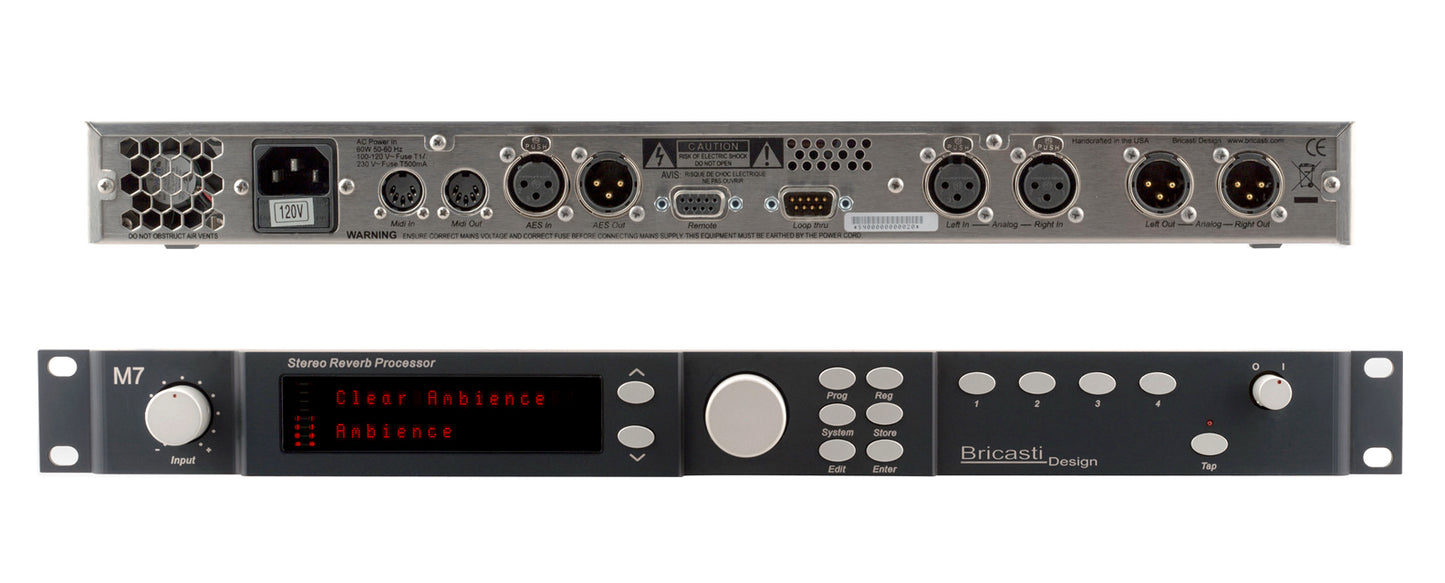
Bricasti Design M7 Stereo Reverb Processor is a dedicated high-resolution stereo hardware reverb processor for critical professional audio rooms.
Built for critical listening, repeatable sessions, and long-term studio integration.
Overview
The Bricasti Design M7 is a dedicated stereo hardware reverb processor for engineers who want dimensional, editable acoustic spaces without relying on a host computer. Its high-resolution DSP platform, premium analog path, and tactile interface make it a reference-class centerpiece for critical rooms.
At a Glance
| Format | 1U stereo reverb processor |
|---|---|
| Control | Front panel; optional M10 remote |
| Processing | True Stereo Reverb Process; six dual-core DSPs |
| I/O | Balanced analog XLR and 24-bit AES/EBU |
| Sample rates | 44.1 to 192 kHz over AES |
| Build | Handcrafted in the USA |
What Is the M7?
The Bricasti Design M7 is a dedicated stereo hardware reverb processor for engineers who want dimensional, editable acoustic spaces without relying on a host computer. Its high-resolution DSP platform, premium analog path, and tactile interface make it a reference-class centerpiece for critical rooms.
Why Use Dedicated Hardware Reverb in a Professional Studio?
Dedicated processing keeps reverb recall and control independent of DAW CPU resources while providing direct analog and AES integration. The M7's user registers, favorites, and editable program parameters support repeatable session workflows.
Key Features
- More than 200 factory programs across halls, plates, rooms, chambers, and ambient spaces
- 100 user registers and 12 editable program parameters
- Four front-panel favorites on the M7
- Separate analog and digital modules with dedicated power architectures
- Balanced, DC-coupled analog circuitry
- M10 remote and multi-machine system support
Technical Specifications
| Processing | True Stereo Reverb Process; six dual-core Analog Devices DSPs |
|---|---|
| Programs | More than 200 reverb presets; 100 user registers; 12 program parameters |
| Digital I/O | 24-bit AES/EBU on XLR; single-wire operation through 192 kHz |
| Digital sample rates | Self-clocking from 44.1 kHz to 192 kHz |
| Analog I/O | Balanced XLR; fully balanced, DC-coupled input and output circuits |
| Analog input | >116 dB A-weighted dynamic range; <0.001% THD+N; +24 dBu maximum |
| Analog output | >116 dB A-weighted dynamic range; <0.001% THD+N; +24 dBu maximum |
| Frequency response | 10 Hz to 20 kHz, within 0.05 dB |
| Level control | Analog input level adjustable in 2 dB steps |
| Construction | Stainless-steel chassis; milled anodized-aluminum front panel; separate analog and digital modules |
| Power architecture | Toroidal transformer linear analog supply plus dedicated digital switching supply |
Why Bricasti Design?
Bricasti Design builds focused professional audio hardware in the United States with dedicated processing, carefully separated analog and digital sections, robust metalwork, and direct workflow controls. The result is equipment designed for recording, mixing, mastering, post-production, broadcast, and other critical listening environments.
Frequently Asked Questions
What is the Bricasti Design M7?
The M7 is a professional stereo digital reverb processor with Bricasti's True Stereo Reverb Process, high-resolution DSP, analog and AES/EBU I/O, and direct front-panel control.
What sample rates does the M7 support?
Its AES digital input self-clocks from 44.1 kHz through 192 kHz using a 24-bit single-wire AES connection.
Can the M7 be controlled remotely?
Yes. The optional M10 Remote Console connects through the M7's RS422 serial interface and can control multi-machine systems.
Does the M7 include analog and digital connections?
Yes. It provides balanced XLR analog input and output plus balanced AES/EBU digital input and output.
Who should choose the M7?
It is designed for recording, mixing, mastering, post-production, broadcast, and other critical professional audio rooms that need dedicated hardware reverb.