


Backed by us. Trusted by you.
Victory isn't given. It's earned.
We build our own instruments and carry the pro audio and video brands we trust, for everyone from first-timers to working pros, from your garage to the big stage. Started in 2017.
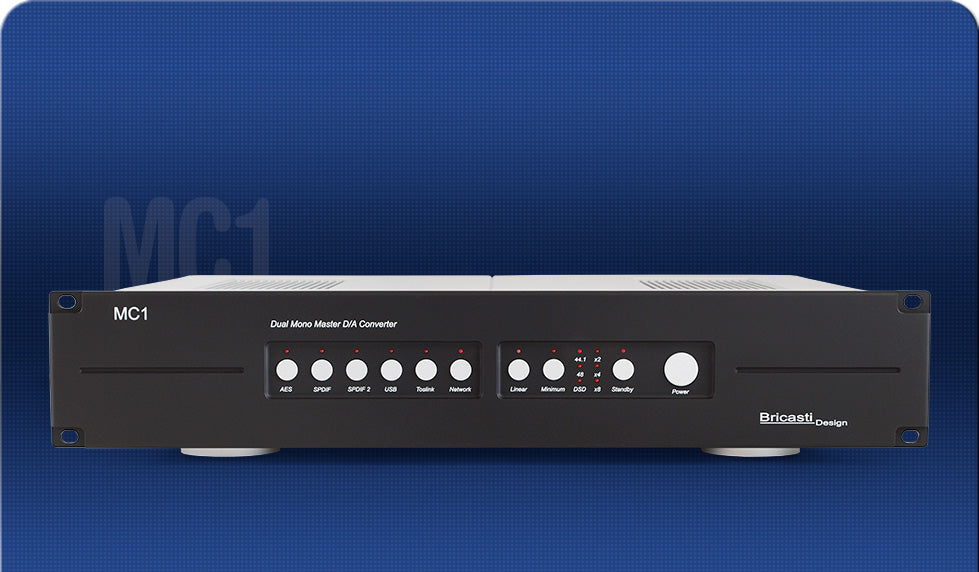
Bricasti Design MC1 Reference Dual Mono D/A Converter is a fully differential dual-mono reference converter for critical monitoring, mastering, and high-resolution playback.
Built for critical listening, repeatable sessions, and long-term studio integration.
Overview
The Bricasti Design MC1 is a fully differential dual-mono reference D/A converter for critical monitoring, mastering, and high-resolution playback. Each channel has its own linear power supply, DAC, DDS clock, and analog circuitry to preserve separation, timing, and harmonic integrity.
At a Glance
| Architecture | Fully differential dual mono |
|---|---|
| PCM | Up to 384 kHz over USB and optional Ethernet |
| DSD | DSD64 and DSD128 as DoP over USB and optional Ethernet |
| Inputs | AES, S/PDIF RCA/BNC, Toslink, USB; optional Ethernet |
| Outputs | Balanced XLR and unbalanced RCA |
| Dynamic range | >120 dB A-weighted |
What Is the Bricasti Design MC1?
The Bricasti Design MC1 is a fully differential dual-mono reference D/A converter for critical monitoring, mastering, and high-resolution playback. Each channel has its own linear power supply, DAC, DDS clock, and analog circuitry to preserve separation, timing, and harmonic integrity.
Why Does the MC1 Use a Dual-Mono Architecture?
Isolating the two channels minimizes analog crosstalk and prevents the power and clocking demands of one channel from modulating the other. Bricasti also isolates the digital processing with its own supply.
Key Features
- Two isolated conversion channels with dedicated linear supplies
- Twin ADI 1955 converters used in mono configuration
- Bricasti proprietary digital filter technology
- Asynchronous, galvanically isolated USB interface
- Balanced and unbalanced analog outputs
- Optional Ethernet input for network playback
Technical Specifications
| Architecture | Fully differential dual mono; isolated channels with dedicated linear supplies, DACs, DDS clocks, and analog circuitry |
|---|---|
| Digital inputs | AES/EBU XLR, two S/PDIF inputs on RCA and BNC, Toslink optical, USB 2, optional RJ45 Ethernet |
| AES and S/PDIF | 44.1 to 192 kHz; DSD64 as DoP |
| USB | 44.1 to 384 kHz; DSD64 and DSD128 as DoP |
| Optional Ethernet | 44.1 to 384 kHz; DSD64 and DSD128 as DoP |
| Jitter | 8 ps at 48 kHz; 6 ps at 96 kHz |
| Conversion | 24-bit delta-sigma PCM with 8x oversampling |
| Analog outputs | Balanced XLR and unbalanced RCA; 40-ohm output impedance |
| Dynamic range | >120 dB A-weighted |
| THD+N at 1 kHz | 0.0006% at 0 dBFS; 0.0004% at -30 dBFS |
| Dimensions | 17 × 12 × 4.5 inches |
| Weight | 15 lb |
| Power consumption | 20 W |
Why Bricasti Design?
Bricasti Design builds focused professional audio hardware in the United States with dedicated processing, carefully separated analog and digital sections, robust metalwork, and direct workflow controls. The result is equipment designed for recording, mixing, mastering, post-production, broadcast, and other critical listening environments.
Frequently Asked Questions
What is the Bricasti Design MC1?
The MC1 is a fully differential dual-mono reference digital-to-analog converter built for critical professional and high-resolution listening applications.
Which digital inputs does the MC1 provide?
It includes AES/EBU, two S/PDIF inputs, Toslink optical, and USB 2, with RJ45 Ethernet available through the optional network interface.
What sample rates does the MC1 support?
AES and S/PDIF support up to 192 kHz, while USB and the optional Ethernet input support PCM through 384 kHz plus DSD64 and DSD128 as DoP.
Does it have balanced and unbalanced outputs?
Yes. The MC1 provides balanced XLR and unbalanced RCA analog outputs with more than 120 dB A-weighted dynamic range.
Why is the MC1 described as dual mono?
Its left and right channels are isolated and each has a dedicated linear power supply, D/A converter, DDS clocking, and analog circuitry.