


Backed by us. Trusted by you.
Victory isn't given. It's earned.
We build our own instruments and carry the pro audio and video brands we trust, for everyone from first-timers to working pros, from your garage to the big stage. Started in 2017.
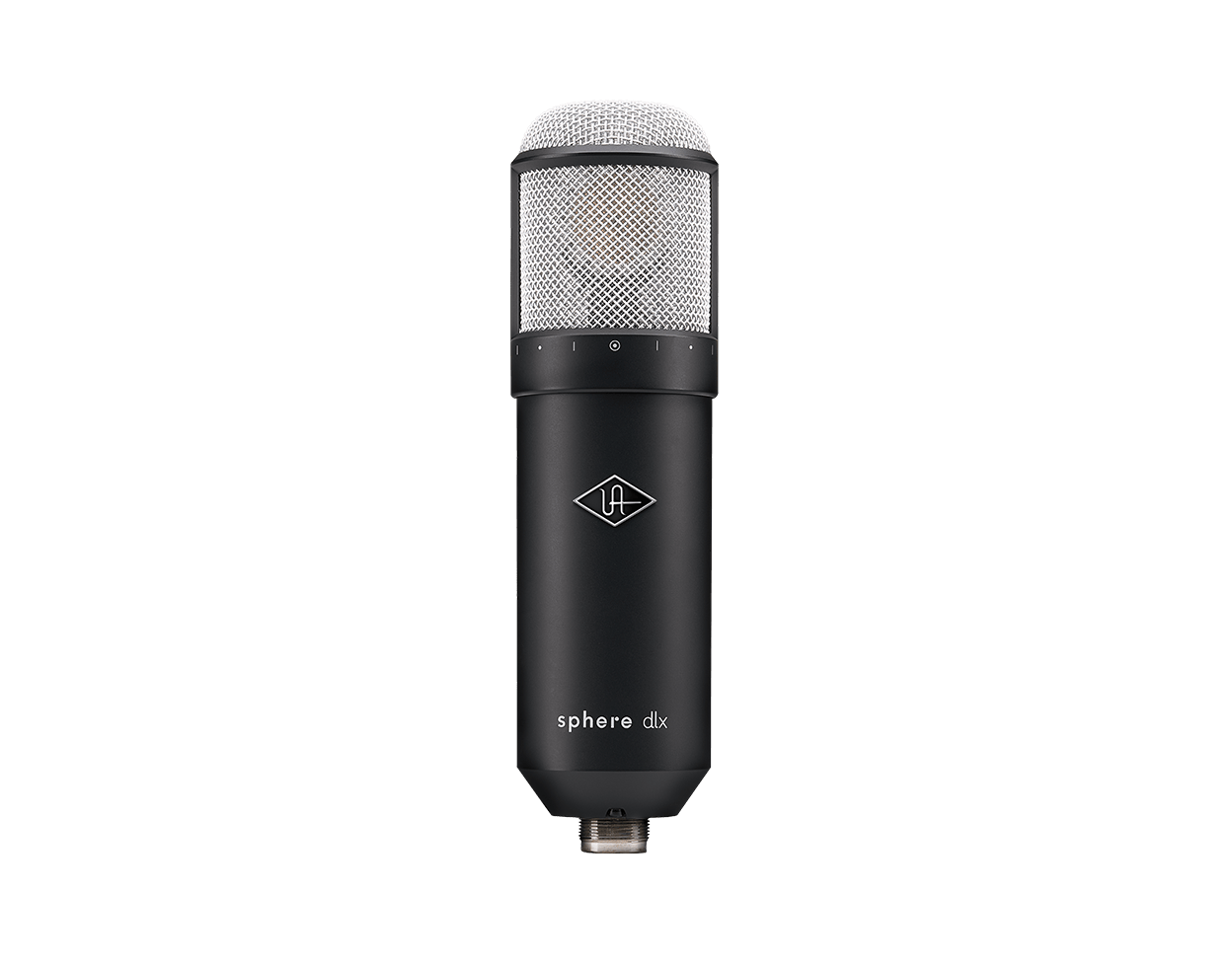
Universal Audio Sphere DLX is a modeling condenser microphone system built on a 1 in. dual-diaphragm capsule with variable dual output, so the microphone model and the polar pattern are chosen after recording. Frequency range is 20 Hz to 20 kHz, sensitivity is -33 dB, maximum SPL is 140 dB at 1% THD with the pad, and dynamic range is 133 dB.
The full Sphere system, at higher sensitivity.
Sphere works differently from every other microphone here. The capsule is a dual-diaphragm design with a variable dual output, meaning the front and rear of the capsule are captured as two separate signals rather than combined inside the microphone. Both go to the software.
Because both halves are recorded, polar pattern is a decision made afterward rather than a switch set before the take. Cardioid, omni, figure-8 and everything between can be changed during mixing, and the microphone's off-axis behavior can be modeled rather than fixed by physics.
That two-signal design is why the connector is a 5-pin XLR rather than the usual 3-pin, and why a dedicated cable is used. It is also what allows Sphere to model specific classic microphones convincingly, since the software has the full spatial picture rather than one summed output.
At a Glance
| Type | Modeling condenser |
| Capsule | 1 in. dual diaphragm |
| Polar pattern | Variable dual output, selectable after recording |
| Frequency range | 20 Hz to 20 kHz |
| Sensitivity | -33 dB, 22 mV |
| Maximum SPL | 140 dB with pad, 1% THD |
| Dynamic range | 133 dB |
| Connector | 5-pin XLRM |
| Phantom power | 48 V DC, 5 mA typical |
How Can I Change the Polar Pattern After Recording?
Both halves of the capsule are recorded separately rather than being summed inside the microphone, so the software holds the front and rear signals independently. Cardioid, omni, figure-8 and intermediate patterns are all derivable from the same take, along with modeled off-axis behavior.
Who Is the Sphere DLX For?
Studios that want the Sphere system as a primary vocal microphone, and engineers who would rather make the microphone decision at mix time than commit during tracking. Its higher sensitivity suits quieter sources than the LX.
How Is the DLX Different From the LX?
Sensitivity and headroom. The DLX is -33 dB sensitivity, 22 mV, with 140 dB maximum SPL using the pad and 133 dB dynamic range. The LX is -39 dB, 11 mV, with 145 dB maximum SPL and 135 dB dynamic range and a specified 10 dBA self-noise. The DLX is more sensitive; the LX takes more level.
What Power Does It Need?
48 V DC phantom power at 5 mA typical, over the 5-pin XLR connection. The 5-pin connector is required because the microphone carries two capsule signals rather than one.
Connections
| Connector | 5-pin XLRM |
| Output impedance | 200 ohms |
| Recommended load impedance | Greater than 1 kilohm |
| Phantom power | 48 V DC, 5 mA typical |
Specifications
| Microphone type | Modeling condenser |
| Polar pattern | Variable dual output |
| Frequency range | 20 Hz to 20 kHz |
| Sensitivity | -33 dB, 22 mV, ref 1 V at 1 Pa, 1 kHz |
| Output impedance | 200 ohms |
| Recommended load impedance | Greater than 1 kilohm |
| Maximum SPL | 140 dB SPL at 1% THD with pad |
| Dynamic range | 133 dB |
| Capsule | 1 in. diameter dual diaphragm |
| Phantom power requirement | 48 V DC, 5 mA typical |
| Connector | 5-pin XLRM |
Why Universal Audio?
Universal Audio was founded in 1958 by M.T. "Bill" Putnam, the engineer who built the first recording console with integrated equalization and effects sends, and who designed the 1176 and the 610. The company was revived in 1999 by his sons and now does two things: it still hand-builds analog hardware in California, and it licenses and models the classics from Neve, API, Manley, SSL, Lexicon, Studer, Ampex and others rather than emulating them without authorization.
Frequently Asked Questions
Is this a genuine Universal Audio product?
Yes. Victory is a veteran owned dealer in Miami and units ship new in original packaging with full manufacturer support, including software registration rights.
Is this covered by warranty?
Yes. This unit carries the full Universal Audio manufacturer warranty, registered to you as the original purchaser. Call 844-687-4208 for the current term.
Do I need a special cable?
Yes. The 5-pin XLR carries two capsule signals rather than one. Replacement cables are available in 10 ft and 25 ft lengths.
How is it different from the Sphere LX?
The DLX is more sensitive at -33 dB against -39 dB. The LX takes more level, at 145 dB maximum SPL against 140 dB with pad on the DLX.
Does it need phantom power?
Yes, 48 V DC at 5 mA typical, supplied over the 5-pin connection.
Why Buy From Victory Musical Instruments?
Victory Musical Instruments is a pro audio and musical instrument dealer in Miami, Florida. We support churches, schools, studios and working musicians across South Florida and ship nationwide. Every unit is new in the original factory packaging with full manufacturer support. Call 844-687-4208 to check lead time, request a quote, or arrange local pickup.