


Backed by us. Trusted by you.
Victory isn't given. It's earned.
We build our own instruments and carry the pro audio and video brands we trust, for everyone from first-timers to working pros, from your garage to the big stage. Started in 2017.
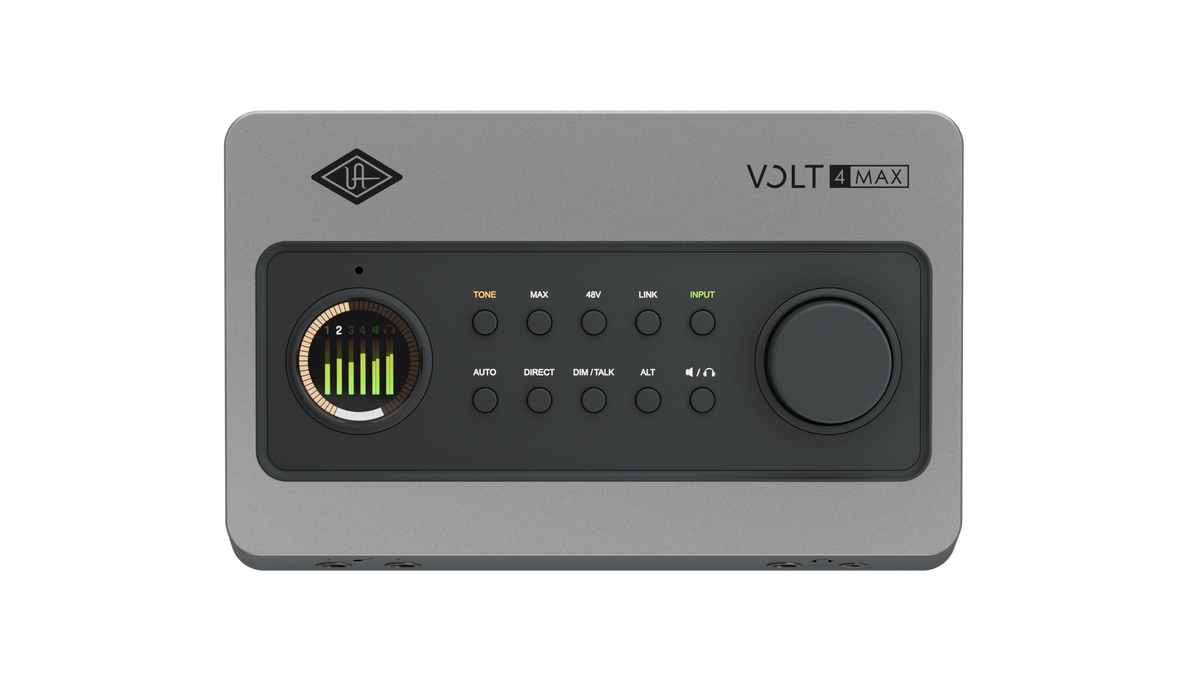
Universal Audio Volt 4 Max is a 12-in / 6-out desktop USB audio interface with 32-bit / 192 kHz conversion, two Tone Shaping Preamps carrying harmonic saturation, Max realtime compression with six presets built on the LA-2A, 1176 and discrete VCA algorithms, speaker switching between two monitor pairs, a built-in talkback microphone, ADAT or S/PDIF optical input and MIDI In and Out.
A record making machine for a real control room, monitor switching and all.
Volt 4 Max is a next generation desktop USB audio interface with two Tone Shaping Preamps, a Smart Display with bright visual feedback, speaker switching, and Max dynamics processing. Taken together it packs the rich, full sound of a pro studio into the smallest footprint possible.
Built by the same Universal Audio team as the Apollo interfaces, Volt Max gives you studio mic preamp tones and classic compression at the push of a button. Six push-button presets ranging from Rap Vocals to Jangly Acoustic deliver big, radio ready sounds based on the 1176 and LA-2A studio compressors. Combined with the three preamp modes, that puts 18 sonic possibilities at your fingertips, all of them completely noise free.
The I/O keeps up. Dual mic and Hi-Z instrument inputs plus extra line channels record several sources at once, clean 48V phantom power feeds studio condensers, MIDI connects controllers and synths, and ADAT adds eight more digital inputs. The ALT button flips monitoring between two sets of speakers so you can check a mix on a second reference.
Volt 4 Max at a Glance
| Format | Desktop USB audio interface, bus powered |
| Simultaneous I/O | 12-in / 6-out |
| Mic preamps | Two, 60 dB available gain, with Tone Shaping, harmonic saturation and Max compression |
| Tone Shaping modes | Warmth, Focus, Shine, each with harmonic saturation |
| Max Processing | Six realtime compression presets for vocals, guitars and bass |
| Conversion | 32-bit, up to 192 kHz |
| Instrument inputs | Two front-panel Hi-Z |
| Speaker switching | Two stereo monitor pairs, main and alt |
| Talkback | Built-in microphone |
| Digital input | ADAT or S/PDIF optical, up to eight channels |
| MIDI | In and Out, 1/8 inch TRS mini-jack, MIDI Type A |
| Display | Full colour Smart Display with gain reduction metering |
| Headphone outputs | Two stereo, one shared cue mix |
| Connection | USB Type-C, USB 2.0 class compliant, onboard USB hub |
| Software included | UAD Volt Studio Bundle and LUNA |
Who Is Volt 4 Max For?
Volt 4 Max replaces the Volt 476P for the engineer working out of a small room. Two channels of compressed, tone shaped input, four line inputs, two headphone outputs and, the part that matters daily, the ability to flip between two sets of monitors without an external switch box. If you need four mic preamps for a band or a drum kit, go to Volt 4P Max.
What Do the Tone Shaping Preamps Sound Like?
Every Volt Max preamp has a TONE button. Off is a clean preamp with 60 dB of transparent gain. Three further voicings colour the signal on the way in, and on the Max models each one adds harmonic saturation on top of the EQ, which is what Universal Audio means by a Unison Lite preamp.

Thick, dark and warm EQ with rich harmonics.

Mid-focused and tight EQ with harmonic edge.

Presence and shine EQ with harmonic sizzle.
What Does MAX Processing Do?
MAX is a second button and a second layer. It puts Universal Audio's realtime compression on the input channel, running on onboard DSP, so it is noise free and it records to the track. Six presets cover the jobs people actually need, and a seventh position tracks flat. Paired with the three TONE voicings that is over 18 character combinations from two buttons.

1176. Classic 8:1 vocal compression.

LA-2A. Smooth rap vocal limiting.

1176. Fast release 4:1 vocal compression.

1176. Pushes back spikey guitar peaks.

LA-2A. Deep tube opto compression.

Discrete VCA. Clean envelope control for bass.

Track flat and decide later with plug-ins.
What I/O Does Volt 4 Max Have?
| Instrument inputs 1-2 | 1/4 inch TS unbalanced, 1 Megohm, 60 dB available gain |
| Microphone inputs 1-2 | XLR combo jack, pin 2 positive, 2 Kilohms, +48V switchable per channel |
| Line inputs 1-2 | 1/4 inch combo jack, TRS balanced or TS unbalanced, 10 Kilohms |
| Line inputs 3-4 | 1/4 inch TRS balanced or TS unbalanced, 10 Kilohms |
| Monitor and line 3-4 outputs | 1/4 inch TRS balanced or TS unbalanced, DC coupled, two stereo monitor pairs with main and alt switching |
| Headphone outputs | Two stereo, 1/4 inch and 1/8 inch TRS, DC coupled, one shared cue mix |
| Digital / optical | ADAT or S/PDIF optical input. ADAT gives 8 channels at 44.1 and 48 kHz, 4 channels at 96 kHz and 2 channels at 192 kHz with S/MUX. S/PDIF gives 2 channels at all supported rates |
| MIDI | In and Out, 1/8 inch TRS mini-jack, MIDI Type A |
| Talkback | Built-in microphone |
| USB | One USB 2.0 host port, one USB hub port supplying 5VDC at 0.5A maximum, one USB external power input requiring 5VDC at 1.5A minimum, 3A supplied with the unit, USB Type-C connectors |
What Software Comes with Volt 4 Max?
Every Volt includes a curated set of UAD plug-ins and instruments, the same software used to make and mix records for decades, plus LUNA, Universal Audio's digital audio workstation with analog emulation and tools that shorten the setup work. Bundle contents are subject to change without notice.

| UAD Volt Studio Bundle | LUNA Digital Audio Workstation, Topline Vocal Tune, UA 610 Tube Preamp & EQ Collection, Century Tube Channel Strip, Teletronix LA-2A Tube Compressor, UA 1176 Classic FET Compressor, Pure Plate Reverb, Galaxy Tape Echo, Oxide Tape Recorder, Vibe Analog Machines, PolyMAX Synth, Anthem Analog Synth, UAD Lion '68 Super Lead Amp, UAD Showtime '64 Tube Amp |
| Additional software | Melodyne Essential by Celemony, Ampeg SVT-VR Classic Bass Bundle by Plugin Alliance (SVT-VR Classic, bx_Tuner, bx_Masterdesk_Classic), Virtual Drummer DEEP by UJAM, Virtual Bassist DANDY by UJAM, Splice INSTRUMENT, Prisma Producer Lab by UVI, FL Studio Producer Edition for three months |
What Are the Full Volt 4 Max Specifications?
| Supported sample rates | 44.1, 48, 88.2, 96, 176.4 and 192 kHz |
| Bit depth | 32 |
| Instrument input dynamic range | 116 dB, A-weighted |
| Instrument input maximum level | 13 dBu |
| Microphone input dynamic range | 119 dB, A-weighted |
| Microphone input THD plus noise | -110 dB, 0.0003 percent at 1 kHz |
| Microphone input maximum level | 14 dBu |
| Line input dynamic range | 119 dB, A-weighted |
| Line input maximum level | 22 dBu |
| Monitor and line output dynamic range | 126 dB, A-weighted |
| Monitor and line output maximum level | 20.2 dBu |
| Monitor output impedance | 200 Ohms |
| Headphone output dynamic range | 116 dB, A-weighted |
| Headphone output power | 45 mW into 32 Ohms, 24 mW into 300 Ohms |
| USB bus powered | Yes |
| Power consumption at 5VDC | 5.5W typical, 7.1W maximum |
| On / off switch | Yes, rear panel |
What Do I Need to Run Volt 4 Max?
| Mac | macOS 12 Monterey or newer, Intel or Apple silicon, available USB 2.0 or higher port |
| Windows | Windows 10 64-bit or newer, Intel or AMD processor, ASIO driver from the UA Connect app |
| iPad and iPhone | iPadOS or iOS 16 or newer |
| DAW compatibility | All major DAWs, including Ableton Live, FL Studio, GarageBand, Logic Pro and Pro Tools |
Lightning equipped iPhone and iPad models need an Apple Lightning to USB Camera Adapter. Devices with USB-C connect directly. Windows systems use the ASIO driver available in the UA Connect app. Bus power requirements vary by model and device.
Which Volt Is Right for You?
Six models share the same converters, the same 60 dB preamps and the same software. They differ in how many sources you record at once, whether the preamps also compress, and what you can plug into the back.

Why Universal Audio
Universal Audio has been building recording equipment since 1958, when Bill Putnam Sr. designed the 610 console and the 1176 limiter that are still the reference for the sound of a record. The modern company builds the Apollo interfaces, UAD plug-ins and the LUNA digital audio workstation. Volt takes the preamp voicings and dynamics algorithms from that catalog and puts them in a bus powered box that fits beside a laptop.
Frequently Asked Questions
What is Max Processing on Volt 4 Max?
Max Processing is onboard realtime DSP compression on the input channels. Six push-button presets cover vocals, guitars and bass, built on Universal Audio's LA-2A, 1176 and discrete VCA algorithms. It is completely noise free and it records to the track, so the sound is committed at the source.
How does speaker switching work on Volt 4 Max?
Volt 4 Max has two stereo monitor outputs, main and alt. The ALT button on the front panel flips monitoring between the two pairs so you can reference a mix on a second set of speakers without unplugging anything.
What is the difference between Volt 4 Max and Volt 4P Max?
Volt 4 Max has two Tone Shaping Preamps. Volt 4P Max has four, so it can track four microphone sources at once. Everything else, including Max Processing, speaker switching, talkback, ADAT and MIDI, is shared between them.
Does Volt 4 Max need a power supply?
It is USB bus powered, and it also ships with a 3A external supply. The USB-C external power input requires 5VDC at 1.5A minimum, and there is an onboard USB hub port for peripherals plus a rear panel power switch.
Is this a genuine Universal Audio product?
Yes. Victory is a veteran owned dealer in Miami and units ship new in original packaging.
Is Volt 4 Max covered by a warranty?
Yes. The unit carries the full Universal Audio manufacturer warranty. Register it with Universal Audio after purchase and keep your receipt.
Why Victory Musical Instruments
Victory Musical Instruments is a Miami pro audio and musical instrument dealer. We are an authorized retailer for Universal Audio, we hold manufacturer pricing on every line we carry, and we answer the phone. Call 844-687-4208 for system advice or a quote.